
 |
| Set up and Ready for Machine Quilting |
Welcome to my sewing studio, bloggy friends! No, I haven't started quilting yet, but I did spend some time in the studio yesterday, clearing the mountains of fabric, rulers, sewing magazines, tools, and mending off this folding table so I could move it in front of my sewing cabinet. I would have moved the table even closer to my chair, except the back end of the table is already hitting my mammoth cutting table and that's way too heavy for me to move. I already had another folding table set up behind my red sewing machine cabinet (which is a Bernie-Built exclusive, in case you're wondering), so now the weight of the quilt will be supported on all sides while I'm quilting. It's really important that the quilt isn't hanging onto the floor, so you don't have to fight the force of gravity while you're trying to quilt. My sewing machine is lowered so it's flush with the top of the cabinet, with a clear acrylic piece filling the gap between the machine and the table top. I ordered the acrylic insert from one of the major sewing machine cabinet manufacturers, made to fit my machine make and model, and then I had Bernie cut the hole in the cabinet top to fit the acrylic insert.
 |
| Nylon Monofilament Thread on Thread Stand |
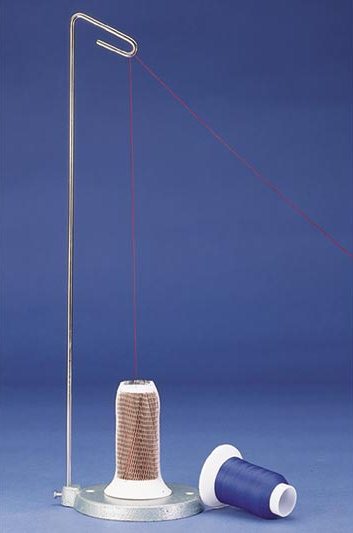
I'm using a high quality invisible thread from SewArt International, which is always the first step towards success. Cheap thread is never worth the grief it causes, and neither is old, brittle thread. Second, I've put the invisible nylon thread on a silly thread stand contraption that hooks onto the back of my sewing machine, the Multiple Spool Holder accessory. The thread stand is silly only because it holds a ridiculous number of thread spools, and the sewing machine only has one needle -- at most, you might use three spools at once with a triple wing needle. It's supposed to facilitate machine embroidery work, and I bought it thinking that I would line up different color threads in order of stitching for embroidery designs, but in reality, I rarely ever embroider designs with enough color changes to warrant the stand. So the Multiple Spool Holder is overkill for quilting, but I'm using it so the nylon monofilament thread can sit vertically on the stand and, although it comes off the spool kind of curled and kinky, the thread has plenty of opportunity to relax and learn some manners as it travel up to the loop at the top of the thread stand, then back down to the machine and its tension disks, preventing the snarling and kinking problems that can sometimes happen with this thread.
 |
| Photo Courtesy Clotilde |
 |
| Invisible Nylon Thread in the Guide Attached to my Sewing Machine |
As I'm editing photos for this post, trying to adjust the brightness so you can actually SEE the invisible thread, I feel like one of the bogus tailors in The Emperor's New Clothes. It's the most beautiful thread in the world, but alas, fools cannot see it... ;-) Don't feel too bad -- I can't see it, either.
Okay, now for the tension samples! Did you think you could thread your machine up with magical invisible nylon thread and sew beautiful stitches without having to make any tension adjustments? Think again, sister! Invisible nylon thread stretches as it goes through the tension disks of your machine, so you are going to need looser needle tension than the standard setting, which is calibrated for sewing with regular weight cotton or polyester construction thread in both the needle and the bobbin. I can't tell you exactly what setting you should use, because the tension numbers are completely arbitrary and vary widely by machine, even within the same brand. The only universal tension truths are that higher numbers equal tighter tension, and nylon thread is going to need looser tension than whatever your standard setting is.
 |
| Monofilament Tension Sample, Top Row is Normal Tension, Gradually Reduced to Bottom Row at 1.25 |
Another point about the bobbin thread: Looking back at my sample stitches again, I can see a tiny dot of bobbin thread between each stitch on the top of my quilt sandwich. This effect was more pronounced when my needle tension was too tight and pulling the bobbin up to the top, but it doesn't completely go away even once my tension is balanced. I'm using a #60 sharp needle to make the smallest hole possible, and that should help, but it's a good reason to select a bobbin thread color that will blend with fabrics in your quilt top instead of a thread color that only looks good with the backing.
I also happily discovered that my sewing machine has a built in quilting straight stitch programmed with 5 tiny little stitches at the beginning and end to lock off stitches. I don't think I've used that in the past, I've just manually turned the stitch length adjuster at the beginning and end of each line of stitching. I'm not sure if I'll use the built in stitch or not -- it's nice at the beginning of the row, because you just tap the "pattern begin" button on the touch screen and start sewing, and the machine automatically increases to the correct stitch length after locking in the stitches without having to take your hands off the fabric. The annoying part is at the end, when my foot is on the pedal and I reach up to hit the "pattern end" button to tell the machine to go back to the tiny stitches to end the row. If I don't tap the button just right with my fingertip, the machine keeps sewing the longer stitch length while I tap it again and again, waiting for the chime that means "yes, Master" in Sewbaby Speak. We'll see how that goes.
So much for the "quick blog post" I planned to write this morning! Hopefully next time I post, I will have made some progress with the actual quilting.
UPDATED February 18th, 2014: I did some quilting with monofilament nylon on my Bernina 750 QE for the first time a couple of days ago. She handled it beautifully, with cotton thread in the bobbin and top tension reduced to 2.0. I did place the monofilament nylon on my thread stand behind the machine and did everything else the same way I did on my previous Artista 200/730 E.
PSST!! I'd Love to Quilt for YOU!
By the way, if you or any of your quilty friends has a quilt top or two that needs quilting, I'd be delighted to quilt for you! My turnaround for edge-to-edge quilting is currently running about 2 weeks, and you can click here to find out how to book your quilt with me.

11 comments:
I have not been able to find Sew Art International thread for many weeks. Do you have a source? They are definitely the best.
I would love to know if you have found sew art international nylon thread. I have been looking for it for weeks. Let me know where you found it .. pretty please.
QuilterPam -- I wanted to reply to you personally but your email address didn't come through with your comment.
Because I'm a packrat, I had two spools of clear and one spool of smoke SewArt monofilament nylon thread in my stash that have been there for several years. I may have bought them from the Bernina dealer where I took my mastery classes for my machine, or I may have purchased it online when I was first reading and learning about machine quilting. In any case, I did a quick search and my usual online thread sources don't seem to carry SewArt now. I wanted to pick up an extra spool from my machine dealer when I was getting the bobbin thread and they suggested the YLI monofilament nylon thread as an alternative. I am planning to switch to the YLI in this quilt if/when the SewArt runs out.
I've had great results with other YLI threads -- my serger LOVES the YLI Elite serger thread, and I've used their silk threads as well with great results. Comparing a strand of SewArt next to a strand of YLI Wonder invisible thread, they look identical and have the same strength (breaks just as easily) and I think it's a good substitute. If you can't find the YLI thread locally, I found it online here: http://sewingsupplywarehouse.com/nylbobthread.html
Thanks for stopping by!
I know this is an older post but I wanted to let you know that I was frustrated beyond all belief trying to use invisible thread and was just about to toss it when I "googled" "working with invisible thread" and came upon your post. I can't say thank you enough for the tips. I had tried everything that I knew to get this thread to work and it would not. Who knew the safety pin and free standing thread holder were the trick. THANK YOU SO MUCH!!! Your generosity with your personal knowledge has saved my sanity. :)
For help finding Sew Art thread, I can't find it anywhere, but found YLI a good replacement (perhaps it is the same thing?). My Berninas didn't like Superior threads but I have heard people with other machines do fine with it.... I reduce the tension down even further. If I am using it for indivisible machine applique to 1 or less and I use a heavy thread and a size 60 needle to ensure no bobbin thread comes through to the top. And it doesn't melt with the iron!
I love your post on the monofilament thread. So very helpful! Thank you!!I am 78; have been sewing for many years, but could never master the mono thread. I,too, have Berninas;is there any other brand??? Ha! I am going to tackle the mono now. Joyce
Just like Nicebootsgirl1, I googled nylon thread and found this post. Awesome tips! I don't have a thread stand, but I did reduce the tension to 2.0 (Bernina 530) and used the "mystery" hook next to the thread spool. I also put the thread on the upright thread post in lieu of a thread stand. Altogether these adjustments work great for my ditching.
Thank goodness for this information. I was trying to repair the zipper on a nylon jacket & the nylon thread kept breaking. Following this info I lowered the tension, places the thread on a separate spool (I also put a thread guard on the spool), re-threaded & it was perfect! No mystery hook on my machine but with everything I did it was not needed. Thank you so - the jacket is repaired.
Even more love coming your way! I'm so glad I found this. I kept thinking I was doing something wrong until I read your post. Lower the tension! Always good advice. Thank you!
Thank you so much for this information. It was detailed and understandable. I too have a Bernina and did not understand what that little metal piece on my machine was for. Thanks for taking the time to figure this out and sharing your knowledge
Wish I had seen this post earlier. Thank you, thank you!! I had worked with inivisible thread once before and swore never again. Then I read your tips and the light bulb went on. I was trying to use C&C horrid stuff, switched it out for Sulky much better, I also reduced upper tension and placed spool on an upright spool holder. The first time I was using crappy invisible thread in the upper and bobbin and what a mess! Now it sews like a dream......I can't say thank you enough!
Post a Comment